 Muhammad Muneeb Zafar
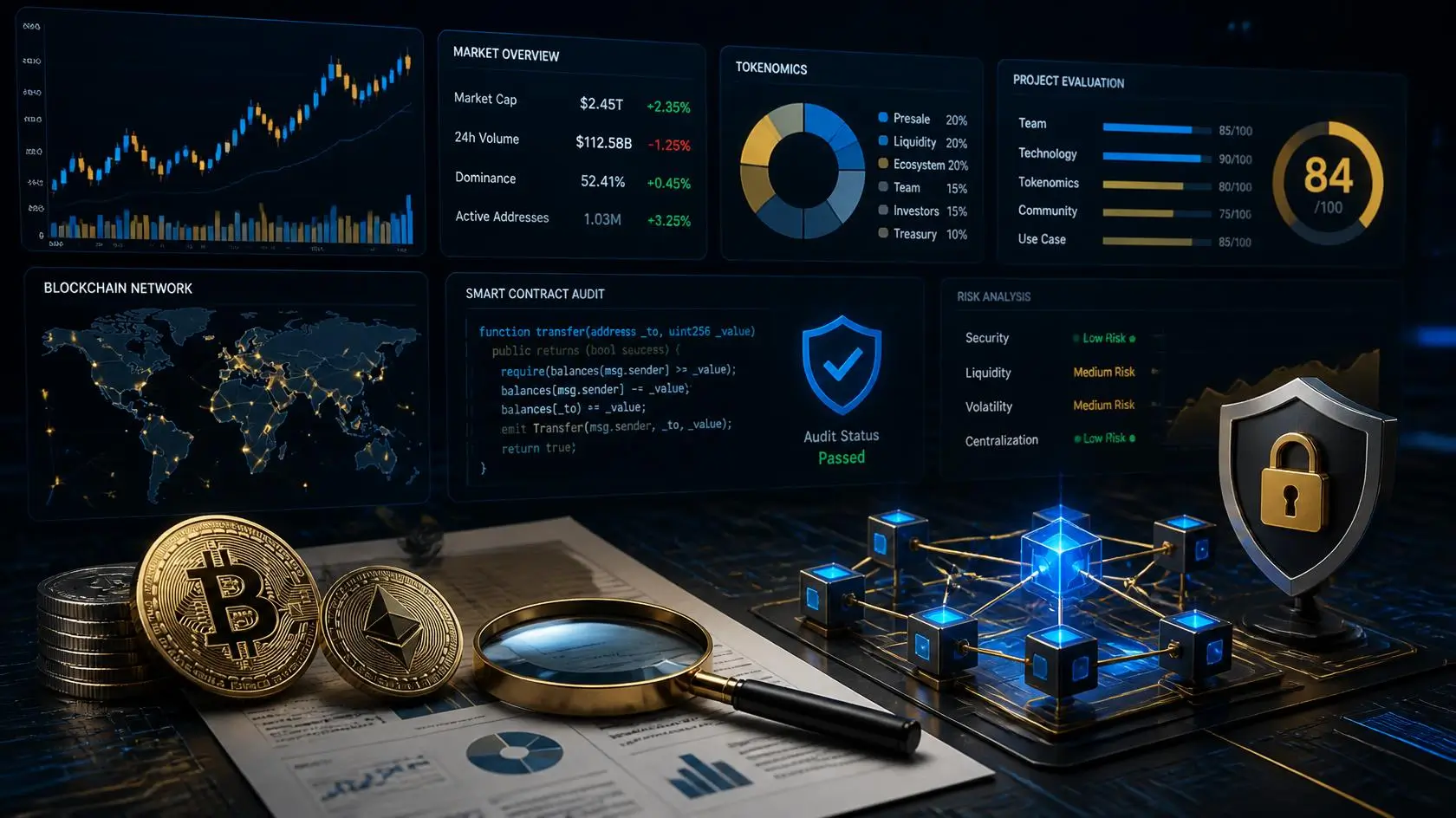
The cryptocurrency market constantly introduces new tokens, blockchain projects, DeFi protocols, gaming ecosystems, AI platforms, and Web3 applications.
Some projects develop useful products and build sustainable communities. Others struggle to deliver on their promises, lose user interest, or fail because of poor token design, security problems, weak liquidity, or excessive speculation.
This makes research especially important when evaluating a new cryptocurrency.
A rising token price, large social-media following, or impressive-looking website does not necessarily mean that a project has strong fundamentals.
Before buying a new token, investors should look beyond the price chart and examine the product, team, tokenomics, usage, security, liquidity, roadmap, competition, and risks.
This guide explains how to research a new crypto project step by step.
Why Research Matters Before Buying a Crypto Token
Crypto markets can move extremely quickly.
A newly launched token can gain attention within hours because of exchange listings, influencers, social-media trends, incentives, or speculation.
But market attention and fundamental value are not the same thing.
A project can have:
- Strong marketing but little product usage
- Thousands of social followers but limited real users
- A high valuation but very few tokens in circulation
- Large funding announcements but weak development
- An impressive roadmap but no working product
- High trading volume but low sustainable demand
Research helps separate these factors.
The objective is not to predict the future with certainty. It is to understand what you are buying and identify major risks before committing capital.
Start With the Project’s Core Purpose
The first question should be simple:
What problem is this project trying to solve?
Read the project’s official website and documentation.
Try to explain the project in one or two sentences without using marketing language.
For example:
“This protocol provides decentralized perpetual trading on an Ethereum Layer 2.”
That is much more useful than:
“We are revolutionizing the future of decentralized financial innovation.”
If you cannot understand what the project actually does after reading its documentation, that should be a reason to slow down.
A strong research process starts with understanding the product before analyzing the token.
Check Whether the Product Actually Exists
One of the easiest mistakes is researching a project entirely through its promotional material.
If the project claims to have a decentralized exchange, open the application.
If it claims to have a blockchain, investigate the network.
If it claims to provide lending, check whether users can actually lend and borrow.
Look for evidence such as:
- Working applications
- Onchain transactions
- Active users
- Trading activity
- Liquidity
- Fees
- Revenue where applicable
- Developer activity
- Regular product updates
Actual usage is generally more informative than promotional claims.
A project with a simple product and genuine users may deserve more attention than a highly polished project with little evidence of adoption.
Read the Whitepaper and Documentation
A project’s whitepaper or technical documentation can provide information that is missing from its homepage.
Look for explanations of:
- Technology
- Product architecture
- Token utility
- Supply
- Distribution
- Governance
- Incentives
- Roadmap
- Security model
- Revenue model
CoinGecko also recommends reviewing a project’s whitepaper and comparing its original plans with what the project has actually delivered.
Do not read the document simply because it exists.
Ask whether the document provides specific, understandable information.
Questions to Ask
Does the documentation explain how the product works?
Does the token have a clear purpose?
Are the token allocations disclosed?
Are vesting schedules available?
Does the roadmap contain measurable milestones?
Does the current product match the project’s original claims?
If important information is consistently vague, consider that a warning sign.
Research the Team
The people behind a project can provide useful context.
Check whether founders and key contributors have:
- Verifiable professional backgrounds
- Previous blockchain experience
- Relevant technical skills
- Previous projects
- Public development contributions
- Industry experience
An anonymous team is not automatically proof that a project is fraudulent.
However, anonymity combined with concentrated token ownership, weak documentation, limited history, and unclear governance can increase uncertainty.
Also investigate major partnerships.
A project may display dozens of logos on its website, but you should determine whether those organizations have actually confirmed the relationship.
Do not treat a logo on a website as proof of a partnership.
Analyze Tokenomics Carefully
Tokenomics is one of the most important parts of crypto-project research.
Tokenomics describes the economic structure of a cryptocurrency, including its supply, distribution, utility, vesting and incentives.
At minimum, check:
- Circulating supply
- Total supply
- Maximum supply
- Market capitalization
- Fully diluted valuation
- Team allocation
- Investor allocation
- Community allocation
- Treasury allocation
- Vesting schedules
- Future unlocks
- Token utility
Circulating Supply vs Total Supply
Suppose a project has a maximum supply of 1 billion tokens but only 100 million are currently circulating.
The current market capitalization may look relatively small, but the future supply could increase substantially.
That means investors should not look only at the current market cap.
Fully diluted valuation can provide another perspective by considering the value of the project if the relevant future supply were circulating.
Check Token Unlocks
Token unlocks deserve special attention when researching new crypto projects.
Team members, private investors, advisors and ecosystem participants may receive tokens that become transferable according to a vesting schedule.
When large quantities of tokens enter circulation, potential selling pressure can increase.
Check:
- Next unlock date
- Number of tokens being unlocked
- Percentage of circulating supply
- Who receives the unlocked tokens
- Frequency of future unlocks
Dedicated token-unlock trackers can help researchers monitor upcoming releases.
A project does not automatically become a bad investment because it has future unlocks.
The important question is whether the market can absorb the additional supply and whether demand is growing at a similar pace.
Understand the Token’s Utility
A token should have a reason to exist.
Ask:
What can users actually do with this token?
Potential utilities include:
- Governance
- Staking
- Network fees
- Access to applications
- Collateral
- Protocol incentives
- Payments
- Security
- Discounts
- Ecosystem participation
But simply having a “utility” section in a whitepaper is not enough.
Ask whether users actually need the token.
If the entire investment thesis depends on people buying the token because they expect its price to rise, the underlying demand mechanism deserves particularly careful examination.
Investigate the Smart Contract
If you are researching a token deployed on an existing blockchain, find its official contract address and inspect it through the appropriate blockchain explorer.
Blockchain explorers can provide information about:
- Contract activity
- Token holders
- Transactions
- Contract verification
- Transfers
- Ownership information
- Other onchain activity
Ledger also recommends using blockchain explorers such as Etherscan as part of crypto-project research because important smart-contract information is publicly accessible.
Why Contract Verification Matters
A token’s name and ticker can easily be copied.
Scammers can create tokens with names that resemble legitimate projects.
Always verify the contract address through an official project source before interacting with it.
Do not rely solely on a token name or logo.
Look at Token Holder Concentration
Holder distribution can reveal another important risk.
If a very large percentage of the circulating supply is controlled by a small number of wallets, those wallets may have significant influence over liquidity, governance or selling pressure.
However, raw wallet rankings require context.
Large addresses can belong to:
- Exchanges
- Bridges
- Burn addresses
- Protocol contracts
- Treasury wallets
- Liquidity pools
Therefore, do not automatically assume that every large wallet is an individual investor.
Investigate the addresses and understand what they represent.
Check Liquidity
A token can have a high displayed market capitalization while having relatively limited actual liquidity.
Low liquidity can make it difficult to buy or sell larger positions without significantly affecting the market price.
Check:
- Trading pairs
- Liquidity pools
- Daily trading volume
- Exchange availability
- Slippage
- Market depth
A token with extremely low liquidity can carry substantially more execution risk than its headline market cap suggests.
Examine Trading Volume
Trading volume can tell you whether there is meaningful market activity.
But volume should not be viewed in isolation.
Ask:
- Is volume consistent?
- Is it concentrated on one exchange?
- Is liquidity deep enough?
- Are there suspicious transaction patterns?
- Does volume disappear when incentives end?
Some apparent activity may be driven by short-term speculation or artificial trading.
The goal is to determine whether there is genuine and sustainable demand.
Research the Project’s Onchain Activity
Blockchain data can provide an additional layer of verification.
Depending on the project, examine:
- Active addresses
- Transaction counts
- Contract interactions
- Token holders
- Protocol deposits
- Trading volume
- Fees
- Revenue
- Treasury activity
For DeFi projects, metrics such as TVL, fees and revenue can help provide a clearer picture of actual usage.
A project with growing users and real fees may have a stronger foundation than one whose growth depends primarily on token incentives.
Evaluate the Security of the Project
Security should be part of your research before interacting with a crypto project.
For smart-contract-based protocols, check whether reputable security firms have audited the relevant contracts.
But remember:
An audit is not a guarantee that a protocol is safe.
A smart-contract audit is designed to identify potential bugs and vulnerabilities, but new code, configuration changes, economic exploits or previously unknown vulnerabilities can still create risk. CoinMarketCap’s explanation of blockchain audits highlights manual analysis, automated testing and reporting as parts of the audit process.
Look for:
- Audit reports
- Security disclosures
- Bug bounty programs
- Contract upgrades
- Admin privileges
- Multisig controls
- Emergency pause functions
Understanding who can change or pause a contract can be particularly important.
Study the Roadmap
A roadmap shows what the project intends to accomplish.
But a roadmap is a plan, not proof of future execution.
Compare promised milestones with actual development.
For example:
Planned: Mainnet launch in Q2.
Reality: Did the mainnet actually launch?
Planned: 100,000 users.
Reality: Is there evidence of meaningful user growth?
This comparison helps distinguish execution from marketing.
A project that consistently delivers milestones may deserve more confidence than one that repeatedly delays major objectives without clear explanations.
Check the Community
Community size can be useful, but follower counts are easy to manipulate.
Instead of asking:
“How many followers does the project have?”
Ask:
“How active and genuine is the community?”
Look at:
- Developer discussions
- Technical questions
- Community feedback
- Governance activity
- Discord discussions
- Telegram conversations
- X activity
- GitHub development
Be cautious if almost every community post consists of price predictions, referral links and “buy now” messages.
A healthy community should contain more than speculation.
Watch for Marketing Red Flags
Some warning signs are obvious.
Be careful with projects promising:
- Guaranteed returns
- Risk-free profits
- Extremely high APYs without explanation
- Guaranteed exchange listings
- Celebrity-backed profits
- Instant wealth
- Limited-time investment pressure
- Secret insider opportunities
Legitimate technology can be marketed aggressively, but extraordinary financial promises should always receive additional scrutiny.
Don’t Confuse Exchange Listings With Quality
Getting listed on a major exchange can increase visibility and liquidity.
But an exchange listing does not automatically prove that a project has strong fundamentals.
Likewise, a token being listed on multiple decentralized exchanges does not guarantee legitimacy.
Treat exchange availability as one data point among many.
Understand Fully Diluted Valuation
FDV can be particularly important when evaluating new tokens.
Imagine two projects:
Project A
Market Cap: $500 million
FDV: $550 million
Project B
Market Cap: $500 million
FDV: $5 billion
The two projects have the same current market capitalization, but their future supply structures are dramatically different.
Project B may have considerably more tokens yet to enter circulation.
That does not automatically mean Project B is overpriced, but it means future dilution deserves careful analysis.
Write Down Your Investment Thesis
Before buying a new token, write down why you believe the project could succeed.
Keep it simple.
For example:
Why could this project succeed?
The product solves a genuine problem and user activity is growing.
What could prove me wrong?
User growth stalls and future token unlocks create significant selling pressure.
What would make me exit?
The team abandons development or the project’s core product loses meaningful usage.
Writing the thesis down can help prevent emotional decisions later.
Common Mistakes When Researching Crypto Projects
Buying Because the Price Is Rising
A rising price does not prove that fundamentals are improving.
Relying on Influencers
Influencers may have incentives or positions that readers cannot see.
Treat influencer commentary as a source of ideas, not final evidence.
Looking Only at Market Cap
Market cap alone ignores future token supply, liquidity and unlock schedules.
Ignoring Token Utility
A token without meaningful demand mechanisms deserves closer examination.
Skipping the Contract
Always verify the official contract before interacting with a token.
Ignoring Competitors
A project can have good technology and still fail because a competitor has stronger adoption.
Spending Too Much on Research Participation
Some projects require users to perform transactions, bridge funds or provide liquidity.
Costs can accumulate quickly without any guarantee of future rewards.
A Practical Crypto Research Process
If you want a simple workflow, use this order:
Step 1: Understand what the project does.
Step 2: Open the actual product.
Step 3: Read the documentation.
Step 4: Research the team.
Step 5: Analyze tokenomics.
Step 6: Check circulating supply and FDV.
Step 7: Review token unlocks.
Step 8: Verify the official contract.
Step 9: Examine holders and liquidity.
Step 10: Check onchain activity.
Step 11: Review audits and security.
Step 12: Compare competitors.
Step 13: Study the roadmap and execution.
Step 14: Evaluate community quality.
Step 15: Write your investment thesis and identify what could invalidate it.
This process does not eliminate risk.
It simply helps you make decisions using more evidence and less hype.
How Long Should Crypto Project Research Take?
A quick first-pass review can often eliminate obviously weak projects.
For a serious investment decision, however, deeper research is appropriate.
A useful approach is to spend enough time to answer the important questions rather than setting an arbitrary deadline.
If you cannot understand the project’s product, token economics or major risks after reviewing its documentation and public data, there is no need to rush.
Sometimes the best research decision is simply not to buy.
Frequently Asked Questions
How do I research a new crypto project?
Start by understanding the project’s product and purpose. Then research its team, documentation, tokenomics, supply, unlocks, security, liquidity, onchain activity, competitors and roadmap.
What should I check before buying a new crypto token?
At minimum, check the official contract address, token supply, market cap, FDV, token allocation, vesting schedule, liquidity, holder concentration, product usage and security information.
Is a high FDV bad for a crypto project?
Not necessarily. However, a large difference between market capitalization and FDV can indicate that substantial token supply has yet to enter circulation. Future unlocks and dilution should therefore be investigated.
Does a crypto audit mean a project is safe?
No. An audit can identify potential vulnerabilities, but it cannot guarantee that a smart contract or protocol will never be exploited.
How can I tell if a crypto project is legitimate?
Look for a functioning product, verifiable team or credible development history, transparent documentation, realistic claims, public onchain activity, clear tokenomics and independently verifiable information.
Should I buy a token because it is listed on a major exchange?
No. An exchange listing can improve liquidity and visibility, but it does not prove that the underlying project has strong fundamentals.
What does DYOR mean in crypto?
DYOR means “Do Your Own Research.” It refers to independently investigating a cryptocurrency, project, tokenomics, risks and available evidence instead of relying solely on influencers or market hype.
Final Takeaway
Researching a new crypto project is not about finding a perfect investment.
It is about understanding the opportunity before taking the risk.
Look beyond the token price and investigate the product, users, team, tokenomics, supply, unlocks, liquidity, security, competition and development progress.
Most importantly, separate evidence from marketing.
A project with a working product, transparent information, meaningful usage and sustainable token economics deserves a very different level of attention from a token whose main selling point is a rapidly rising price.
Good research cannot guarantee profits.
But it can help you identify obvious risks earlier, avoid unnecessary mistakes and make more informed decisions in an extremely volatile market.
Editorial Note: This article is for informational and educational purposes only and does not constitute financial, investment or trading advice. Cryptocurrency markets are highly volatile, and researching a project does not guarantee that its token will increase in value. Always verify information through official sources and conduct your own due diligence before making financial decisions.
Sources & References
- CoinGecko — Crypto fundamental analysis and DYOR framework.
- CoinGecko — Tokenomics, supply, FDV, allocation, vesting and utility.
- Ledger — Using blockchain explorers, whitepapers and community research for DYOR.
- CoinMarketCap — Smart-contract audit overview.
- CoinMarketCap — Token unlock and vesting information.
- PickACrypto — Practical crypto-project due-diligence framework.