 Muhammad Muneeb Zafar
Choosing a crypto exchange in 2026 is about more than finding the lowest trading fee. Security, liquidity, regulation, withdrawals, asset availability and geographic restrictions can matter just as much.
Centralized exchanges (CEXs) provide account-based trading and custody, while decentralized exchanges (DEXs) allow users to trade through blockchain protocols and wallets. Each model has different benefits and risks.
What Is a Crypto Exchange?
A crypto exchange allows users to buy, sell, swap or trade digital assets.
Depending on the platform, features can include:
- Bitcoin and altcoin trading
- Spot markets
- Futures and perpetuals
- Staking and Earn products
- Recurring purchases
- P2P trading
- Fiat deposits and withdrawals
- Web3 wallets
- Institutional services
Not every exchange offers all of these services.
What Makes a Crypto Exchange Good?
Compare several factors rather than relying on one rating:
| Factor | Why It Matters |
|---|---|
| Security | Protects accounts and assets |
| Regulation | Shows the legal framework |
| Fees | Directly affects trading costs |
| Liquidity | Reduces potential slippage |
| Asset selection | Determines available markets |
| Fiat support | Makes deposits easier |
| User interface | Important for beginners |
| Trading tools | Useful for active traders |
| Proof of Reserves | Adds reserve transparency |
| Withdrawals | Important for accessing funds |
| Customer support | Useful when problems occur |
Security Should Come First
Before asking which exchange is cheapest, ask how the platform protects customer funds.
Look for:
- Two-factor authentication
- Withdrawal controls
- Anti-phishing protection
- Cold-storage practices
- Account alerts
- Proof of Reserves
- Security history
- Insurance or protection programs where applicable
Current 2026 exchange comparisons continue to emphasize security, transparency and reserve verification.
What Is Proof of Reserves?
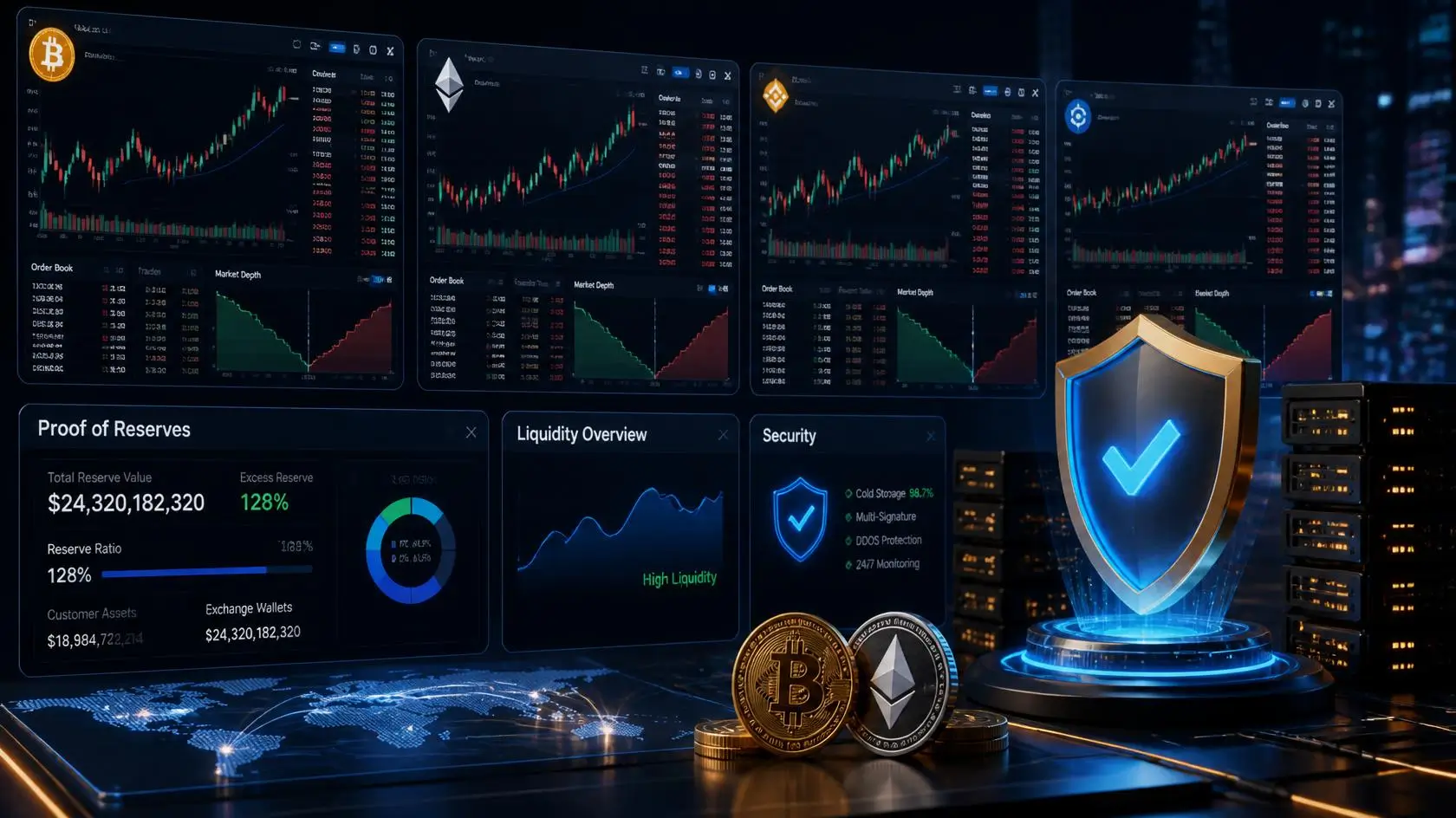
Proof of Reserves (PoR) provides evidence about assets held by an exchange and their relationship to customer liabilities.
However, PoR is not a complete guarantee of solvency. It can be a point-in-time snapshot and may not reveal every off-chain liability.
CoinGecko’s September 2026 review found that only 79 of 166 tracked exchanges had verified reserves.
Therefore, treat PoR as one part of due diligence, not proof that an exchange is risk-free.
Check the Exchange’s Security History
Research whether the platform has experienced:
- Major hacks
- Withdrawal freezes
- Data breaches
- Regulatory enforcement
- Insolvency problems
- Repeated outages
A past incident doesn’t automatically make an exchange unsafe today. Check what happened, whether customers were affected, how the exchange responded and what security measures changed afterward.
Compare Trading Fees
Most professional platforms use maker-taker pricing.
Fees can depend on:
- Trading volume
- Account level
- Token holdings
- Trading pair
- Product
- Maker/taker status
Current 2026 comparisons show meaningful differences between exchanges, so always verify the latest fee schedule before trading.
Don’t Ignore Spreads
A low trading fee doesn’t necessarily mean the lowest total cost.
For example:
Exchange A: 0.10% fee + 0.05% spread
Exchange B: 0.05% fee + 0.30% spread
Exchange B has the lower advertised fee but could still be more expensive overall.
Liquidity Matters
Liquidity determines how easily an asset can be bought or sold without significantly moving its price.
Higher liquidity generally means:
- Deeper order books
- Lower slippage
- Better execution
- Easier large trades
Don’t assume that an exchange listing hundreds of tokens provides deep liquidity for all of them.
What Is Slippage?
Slippage occurs when the execution price differs from the expected price.
It can increase when:
- Markets move rapidly
- Liquidity is low
- Orders are large
- Order books are thin
This is particularly important for active traders and larger positions.
Check Supported Assets
More listings aren’t automatically better.
A broad selection provides choice, but can also mean greater exposure to speculative tokens.
Check whether the exchange supports the specific assets and blockchain networks you actually need.
Fiat Deposits and Withdrawals
Check:
- Supported currencies
- Bank transfers
- Card deposits
- Withdrawal methods
- Deposit fees
- Withdrawal fees
- Processing times
- Regional restrictions
An exchange that works well in one country may offer very different services elsewhere.
Regulation and Licensing
Don’t simply look for a “regulated” label.
Check:
- Which legal entity operates the platform
- Where it is registered
- Which regulator oversees it
- Which products are covered
- Whether authorization applies to your country
Regulatory status can change, so verify current information before depositing funds.
Geographic Availability
An exchange available online isn’t necessarily available to everyone.
Restrictions can apply to:
- Countries
- States or provinces
- Derivatives
- Staking
- Earn products
- Fiat services
- Specific tokens
Current 2026 research shows significant differences between exchanges in Pakistan regarding availability, fees, payment methods and regulatory considerations.
Always check the platform’s current terms for your jurisdiction.
Beginner-Friendly Features
Beginners may prefer:
- Simple buy/sell interfaces
- Recurring purchases
- Easy deposits
- Portfolio tracking
- Educational resources
- Customer support
- Straightforward withdrawals
The best exchange for a beginner may therefore be different from the best platform for a professional trader.
Features for Active Traders
Experienced traders may need:
- Advanced order types
- Limit and stop orders
- Charting
- API access
- Deep liquidity
- Futures
- Perpetual contracts
- Portfolio tools
- Trading bots
Advanced products also introduce additional risks, especially leverage and derivatives.
Spot Trading vs Derivatives
Spot Trading
You buy or sell the actual digital asset.
Derivatives
Futures, perpetuals and options allow traders to speculate or hedge without necessarily owning the underlying asset.
Leverage can magnify both gains and losses. New users should understand these risks before using derivatives.
Exchange Custody vs Self-Custody
When assets remain on a centralized exchange, the platform controls the custody infrastructure.
With self-custody, you control the private keys.
Exchange custody: convenient but carries counterparty and platform risk.
Self-custody: greater control but puts responsibility for seed phrases, transactions and wallet security on you.
Self-custody removes exchange counterparty risk but adds personal security responsibility.
Don’t Keep More on an Exchange Than Necessary
An exchange is useful for trading, but that doesn’t automatically make it ideal for permanent storage.
Long-term holders may prefer self-custody depending on their experience and risk tolerance.
If you keep funds on an exchange, use strong security and understand its withdrawal procedures.
Check Withdrawal Limits
Before depositing significant funds, check:
- Daily limits
- Verification requirements
- Network-specific limits
- Withdrawal fees
- Processing times
- Address-whitelisting rules
Cheap trading isn’t useful if accessing your funds becomes difficult.
Don’t Choose an Exchange Based Only on Reviews
Online reviews can be:
- Sponsored
- Affiliate-driven
- Outdated
- Based on limited experience
- Focused on one country
Compare multiple independent sources and verify important information through official documentation.
Crypto Exchange Comparison Checklist
Before choosing an exchange, ask:
Is it available in my country?
Does it support my required assets?
What are the actual trading fees?
What spreads should I expect?
How deep is liquidity?
Does it provide Proof of Reserves?
What is its security history?
How are accounts protected?
What fiat methods are available?
What are withdrawal fees and limits?
Which products are available in my jurisdiction?
How good is customer support?
How to Compare Two Exchanges
| Factor | Exchange A | Exchange B |
|---|---|---|
| Security | ||
| Regulation | ||
| Proof of Reserves | ||
| Spot fees | ||
| Spread | ||
| Liquidity | ||
| Supported assets | ||
| Fiat options | ||
| Withdrawal fees | ||
| Customer support | ||
| Advanced trading | ||
| Local availability |
Weight the factors according to your needs. A long-term investor may prioritize security, while an active trader may prioritize liquidity and execution costs.
What About Decentralized Exchanges?
DEXs allow users to trade through smart contracts and blockchain wallets rather than depositing funds into a centralized exchange account.
Potential advantages include:
- Self-custody
- Onchain transparency
- Permissionless access
- Decentralized markets
But DEXs also carry risks involving:
- Smart contracts
- Token scams
- Liquidity
- Slippage
- Wallet security
- Network fees
- Irreversible transactions
Decentralization does not automatically mean zero risk.
Common Crypto Exchange Mistakes
Choosing Only the Lowest Fee
Security and liquidity matter too.
Ignoring Withdrawal Costs
Cheap trading can be offset by expensive withdrawals.
Using Leverage Without Understanding It
Losses can increase rapidly.
Assuming Every Exchange Is Available Everywhere
Regional restrictions change.
Keeping Everything on One Platform
Concentration can increase counterparty risk.
Ignoring Account Security
Use 2FA and available account protections.
Trusting Fake Support Accounts
Never give passwords, private keys or seed phrases to supposed support staff.
What Is the Best Crypto Exchange in 2026?
There isn’t one platform that is best for everyone.
Current comparisons highlight different exchanges for different purposes, including security, regulation, liquidity and specialized trading.
The better question is:
Which exchange best matches your requirements?
A Simple Method for Choosing an Exchange
Step 1: Check availability in your country.
Step 2: Verify supported cryptocurrencies.
Step 3: Compare trading fees.
Step 4: Check spreads and liquidity.
Step 5: Research security history.
Step 6: Check Proof of Reserves and its limitations.
Step 7: Review regulatory status.
Step 8: Compare deposits and withdrawals.
Step 9: Check withdrawal limits.
Step 10: Evaluate customer support.
Step 11: Decide whether you need advanced products.
Step 12: Start with a small amount before committing significant funds.
Frequently Asked Questions
What is the best crypto exchange in 2026?
There is no universally best exchange. The right platform depends on your country, trading style, security priorities, fees, liquidity, assets and required features.
What should I look for in a crypto exchange?
Focus on security, regulation, Proof of Reserves, fees, liquidity, asset availability, withdrawals, customer support and geographic availability.
Are low crypto exchange fees always better?
No. Spreads, slippage, withdrawal charges and liquidity also affect total costs.
What is Proof of Reserves?
PoR provides evidence about exchange-held assets and customer liabilities, but it has limitations and isn’t a complete guarantee of solvency.
Are centralized exchanges safe?
They can have strong security controls, but users still face counterparty and platform risks.
Are decentralized exchanges safer?
Not necessarily. DEXs reduce some custodial risks but introduce smart-contract, wallet, liquidity and transaction risks.
Should I keep all my crypto on an exchange?
There is no universal answer. Understand exchange-custody risks before deciding how much to keep there.
How can I reduce exchange risk?
Use strong account security, enable 2FA, verify withdrawal addresses, avoid suspicious links, understand withdrawal rules and consider self-custody when appropriate.
Final Takeaway
Choosing a crypto exchange in 2026 requires more than comparing trading fees.
Security, liquidity, regulation, Proof of Reserves, withdrawals, asset availability and geographic restrictions all matter.
The best exchange for a beginner may not be the best one for an active trader, and the lowest advertised fee may not mean the lowest overall cost.
Compare the factors that actually matter to you, verify current information through official sources, and consider starting with a small amount before depositing significant funds.
Editorial Note: This article is for informational and educational purposes only and does not constitute financial, investment or trading advice. Exchange fees, regulations, supported assets, geographic availability and security conditions can change. Always verify current information through official exchange and regulatory sources before opening an account or depositing funds.
Sources & References
- The Block — 2026 comparison of centralized and decentralized crypto exchanges.
- Kraken Learn — Exchange security, fees, Proof of Reserves and features.
- CoinGecko — September 2026 Proof of Reserves analysis.
- Binance Academy — Proof of Reserves and its limitations.
- Coin Bureau — September 2026 crypto exchange comparison.
- Coin Bureau — August 2026 exchange-security analysis.